
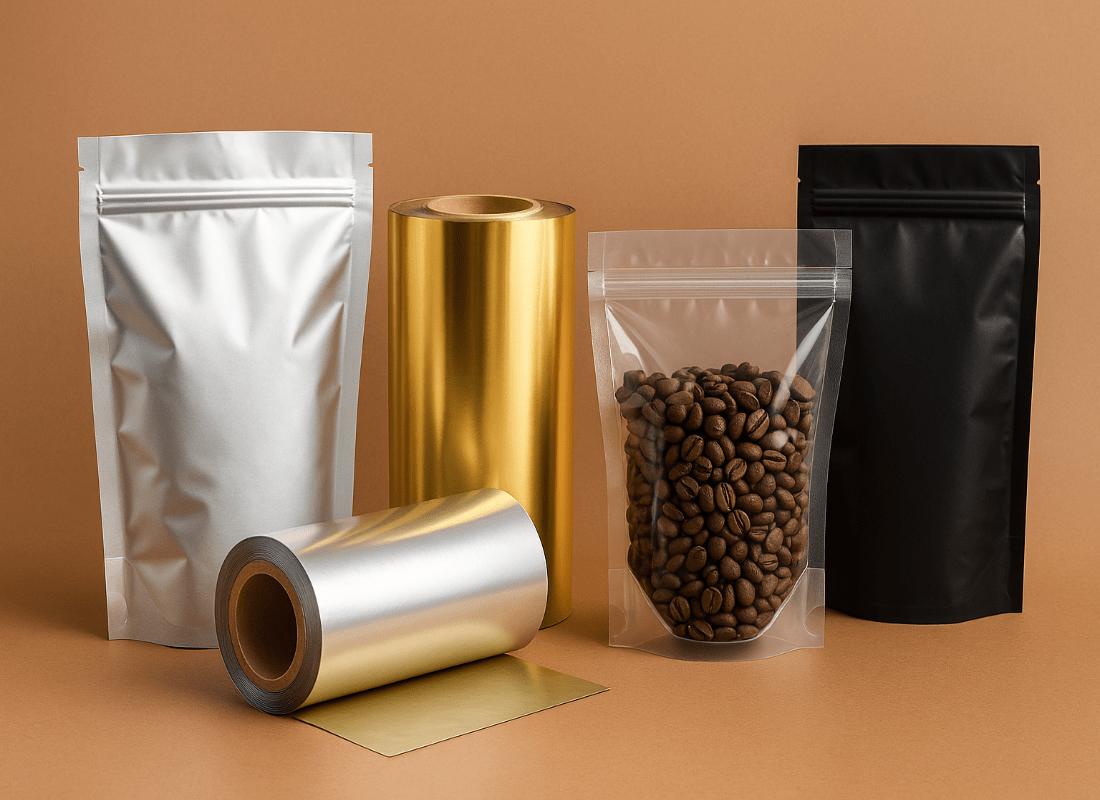
Choosing the right coffee packaging material is essential for protecting freshness, preserving aroma and presenting your coffee brand professionally. Different materials offer different levels of protection against oxygen, moisture, light and external odors.
Whether you sell whole coffee beans or ground coffee, the best packaging structure depends on your product, desired shelf life, filling process, storage conditions and target market.
In this guide, we explain common coffee packaging materials, their key properties and how to choose a suitable structure for your business.
Why Coffee Packaging Materials Matter
Coffee quality can deteriorate when it is exposed to oxygen, moisture, light and unsuitable storage conditions. Ground coffee generally has more exposed surface area than whole beans, which can make freshness management especially important.
A suitable packaging structure can help:
- Reduce oxygen and moisture transmission.
- Protect coffee aroma and flavor.
- Provide sufficient strength for transportation and handling.
- Support reliable heat sealing.
- Meet your brand's appearance and sustainability requirements.
Packaging performance depends on the complete structure, bag design, seals and storage conditions—not simply the name of one material.
Common Coffee Packaging Materials
1. PET/AL/PE Laminated Film
PET/AL/PE is a common multilayer structure used for high-barrier flexible packaging.
- PET (polyethylene terephthalate): Commonly provides printability, stiffness and surface protection.
- AL (aluminum foil): Provides a strong barrier against light, oxygen and moisture when properly converted and sealed.
- PE (polyethylene): Commonly serves as the inner sealing layer.
This structure may be suitable for roasted coffee products that require strong protection and an opaque package.
The actual performance depends on film thickness, lamination quality, seals, valves and the finished bag's construction.
2. High-Barrier Plastic Laminates
High-barrier laminates can combine printable outer films with specialized barrier layers.
They may be suitable for brands seeking a balance between appearance, flexibility and product protection.
Different structures perform differently. Ask your packaging supplier for the relevant oxygen transmission rate (OTR), water vapor transmission rate (WVTR), seal performance and other applicable test data.
3. Mono-Material PE Packaging
Mono-material PE structures are designed to use polyethylene-based layers to support certain recycling-oriented packaging designs.
Potential advantages include flexibility and compatibility with some polyethylene recycling streams.
However, mono-material packaging does not automatically provide the same barrier performance as an aluminum-foil laminate. Recyclability also depends on the final package design and the collection and recycling systems available in the target market.
4. Kraft Paper-Look Coffee Packaging
Kraft-style coffee bags are popular with specialty coffee brands because of their natural appearance.
Many kraft-look pouches use a paper outer layer combined with plastic or other functional barrier layers.
Do not assume that a kraft appearance means a package is fully paper-based, recyclable or compostable. Confirm the actual material structure and disposal requirements.
Comparing Coffee Packaging Materials
| Material structure | Potential advantages | Important considerations |
|---|---|---|
| PET/AL/PE | Strong light, oxygen and moisture barrier | Multilayer construction can complicate recycling |
| High-barrier laminate | Flexible design and a range of barrier options | Performance varies by structure |
| Mono-material PE | Can support certain recyclable packaging designs | Barrier performance and local recycling compatibility must be verified |
| Kraft-look laminate | Natural brand appearance | The outer appearance does not identify the complete structure |
How to Choose the Right Coffee Packaging Material
Step 1: Identify Your Coffee Product
Confirm whether you package whole beans, ground coffee, light-roasted coffee or dark-roasted coffee. Product characteristics influence packaging requirements.
Step 2: Define Your Shelf-Life Target
Consider how long the coffee must maintain its desired quality, along with the expected storage temperature, distribution time and exposure conditions.
Your packaging supplier can help determine the appropriate barrier requirements.
Step 3: Choose the Bag Format
Stand-up pouches, flat-bottom bags, side-gusseted bags and other formats have different space, presentation and filling considerations.
The bag format should work with the selected film structure and your packaging equipment.
Step 4: Consider Degassing Requirements
Freshly roasted coffee releases carbon dioxide. A one-way degassing valve may be appropriate for some roasted coffee packages, but the valve must be compatible with the bag construction and product requirements.
Step 5: Evaluate Sustainability and Cost
Compare material costs, packaging performance, printing needs, transport requirements and the sustainability claims permitted in your target market.
Avoid selecting a material based on a sustainability label alone.
What Information Should You Send Your Packaging Supplier?
To receive a useful recommendation, prepare the following information:
- Whole beans or ground coffee.
- Target bag capacity and dimensions.
- Preferred bag style.
- Required shelf life and storage conditions.
- Whether a one-way degassing valve is needed.
- Printing design and finish requirements.
- Target market and sustainability goals.
- Estimated order quantity.
The more clearly you define these requirements, the easier it is to evaluate suitable packaging options.
Explore Custom Coffee Packaging Solutions
Need help choosing a material for your coffee brand?
Explore our custom coffee packaging bags and pouches to learn about available bag styles, material options and customization possibilities.
Share your coffee type, target capacity and packaging requirements to discuss a suitable solution.