
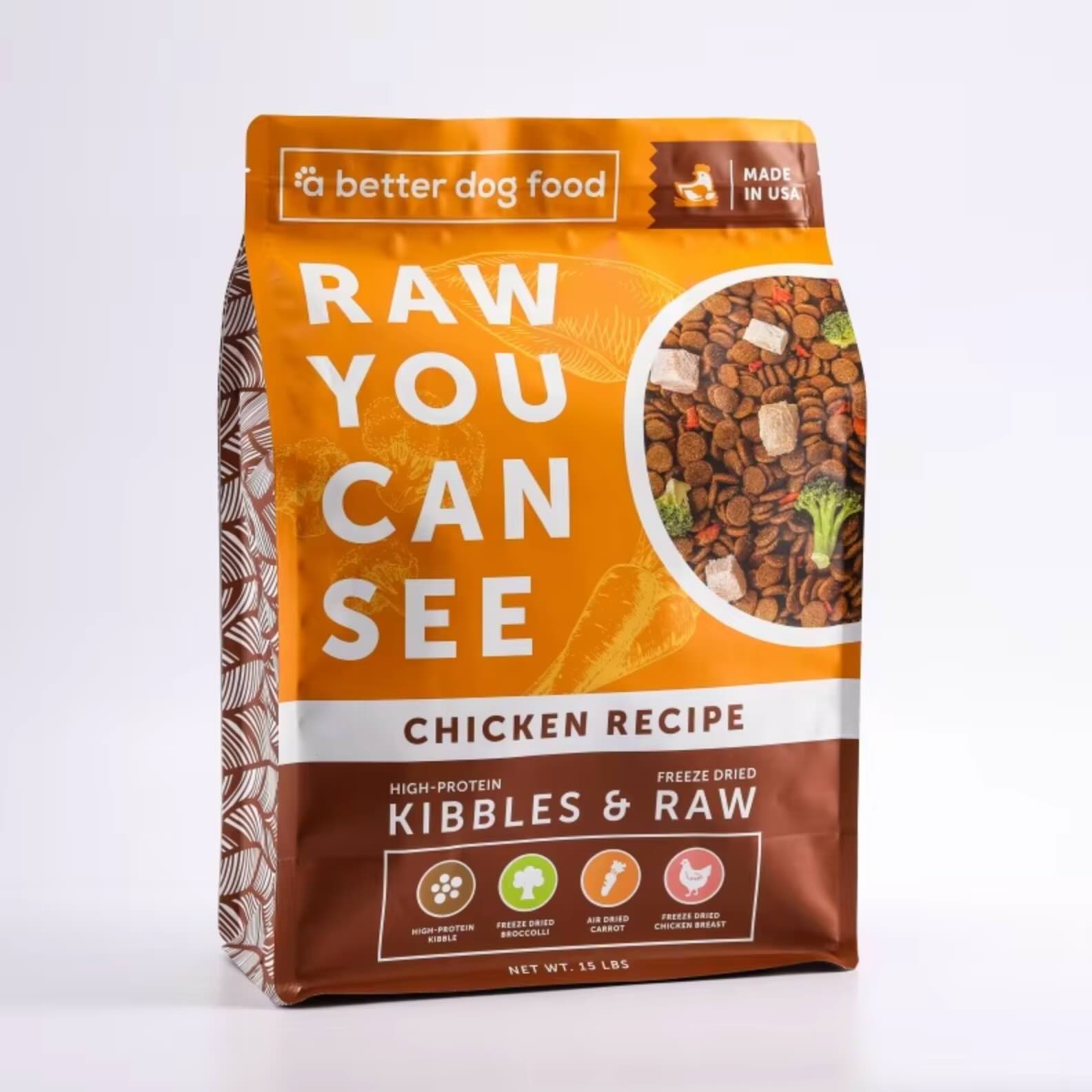
Why the Pouch Shape Decides More Than Price
Pet food buyers judge a bag in about two seconds on a shelf. The format sets how stable it stands, how much you can print, and what it signals about quality. The U.S. pet food packaging market was worth about USD 1.95 billion in 2024 and is forecast to reach roughly USD 3.60 billion by 2035, growing near 5.7% a year. Premiumisation and sustainability are the two forces pushing brands toward better pouches. About 70% of U.S. households own a pet, so the category is too large to package carelessly.
Stand-Up Pouch — Lower Cost, Proven Versatility
The stand-up pouch uses a bottom gusset that opens when filled. It is the default flexible pack for snacks, powders, and treats because it balances cost, looks, and function.
- Lower unit cost and simpler converting.
- Stores flat before filling, which saves warehouse space.
- Works from 50 g trial sizes up to about 1 kg retail packs.
- Accepts zipper, valve, window, and matte or gloss print.
It is the right call for budget SKUs, new-product tests, and lighter fills where shelf posture is not the deciding factor.
Flat-Bottom Pouch — Stability and Premium Shelf Presence
The flat-bottom pouch has a box-like base and side gussets. It typically offers five printable panels — front, back, two sides, and bottom. That changes the game for pet food.
- Holds its posture on a flat shelf, even at 500 g to 2 kg and beyond.
- Gives more room for ingredients, certifications, and brand story.
- Reads as premium next to a leaner stand-up bag.
- Uses more film and costs more to convert.
The advantage grows with fill weight. Above roughly 500 g, a flat-bottom bag stays square while a stand-up pouch can lean or twist.
Side-by-Side Comparison
| Factor | Stand-Up Pouch | Flat-Bottom Pouch |
|---|---|---|
| Shelf stability | Good for most sizes | Excellent, even at heavy fills |
| Printable panels | Front and back mainly | Five panels (front, back, sides, base) |
| Unit cost | Lower | Higher (more film, more sealing) |
| Best fill weight | 50 g – 1 kg | 500 g – 2 kg and above |
| Brand signal | Modern, value-friendly | Premium, structured |
What Pet Food Actually Demands From the Film
Pet food fat oxidises when it meets oxygen and light. That is why pet food is one of the highest-barrier packaging categories.
- A metallised PET/VMPET/PE laminate typically delivers an oxygen transmission rate around 1–2 cc/m²/day and supports 18–24 months of shelf life.
- A foil PET/AL/PE structure pushes oxygen transmission toward zero and is preferred for premium and long-shelf-life export lines.
- For high-fat or long-shelf products, many brands specify OTR below 5 cc/m²/day and moisture transmission below 5 g/m²/day.
Both pouch shapes can use these same high-barrier films. Shape does not set protection — the film structure does.
Don't Forget the One-Way Degassing Valve
Pet food keeps off-gassing after it is packed, releasing CO₂ as it settles. A one-way degassing valve lets that gas escape while blocking outside air and moisture. The result: no bag bloating, less mould risk, and slower oxidation. Suppliers cite roughly 30% longer freshness versus a standard sealed pouch. The valve pairs with PET/AL/PE or PET/VMPET/PE structures and suits raw, fermented, or high-fat recipes most.
Resealable Zipper and Fill Weight Matter
A resealable zipper keeps aroma in and stale air out after first open — a feature pet owners rate highly. Match the format to the fill:
- Under 500 g: a stand-up pouch is usually enough.
- 500 g to 2 kg and up: a flat-bottom pouch earns its cost in stability and presence.
- 5 kg+ wholesale: side-gusset or large-format bags with reinforced handles take over.
Always test with real kibble, not empty samples, before scaling an order.
The Recyclable Mono-PE Shift
Retailers and regulators now expect recyclable packs. Mono-PE pouches keep the EVOH tie-layer under about 5% so they stay in the PE recycling stream, and many carry 10–30% post-consumer recycled content to meet EU PPWR and store recyclability rules. Mars and Nestlé have committed to 100% recyclable or reusable packaging, which pulls the whole supply chain toward mono-material pouches. You can get barrier and recyclability in one structure — ask for the data sheet.
How to Choose for Your Brand
- Channel: crowded retail shelf → flat-bottom. Online-only → either works, stand-up saves cost.
- Fill weight: light trial → stand-up. 500 g+ premium → flat-bottom.
- Brand tier: economy → stand-up. premium → flat-bottom with five panels.
- Barrier need: high-fat or long export shelf → foil or metallised film, either shape.
- Sustainability goal: request mono-PE with PCR and recyclability certification.
- MOQ: many Chinese converters offer digital print from 1,000 pieces, gravure from 5,000 — confirm lead time.
See Custom Pet Food Pouches in Both Formats
3NL builds flat-bottom and stand-up pet food pouches with foil or metallised barrier films, one-way degassing valves, resealable zippers, and mono-PE recyclable options. Tell us your fill weight and shelf channel — we match the structure.
View Pet Food Pouch Options →Talk to 3NL About Your Pet Food Pouch
Share your product, fill weight, and target market. We return a structure recommendation, barrier spec, and a sample plan — fast.
Request a Quote →