
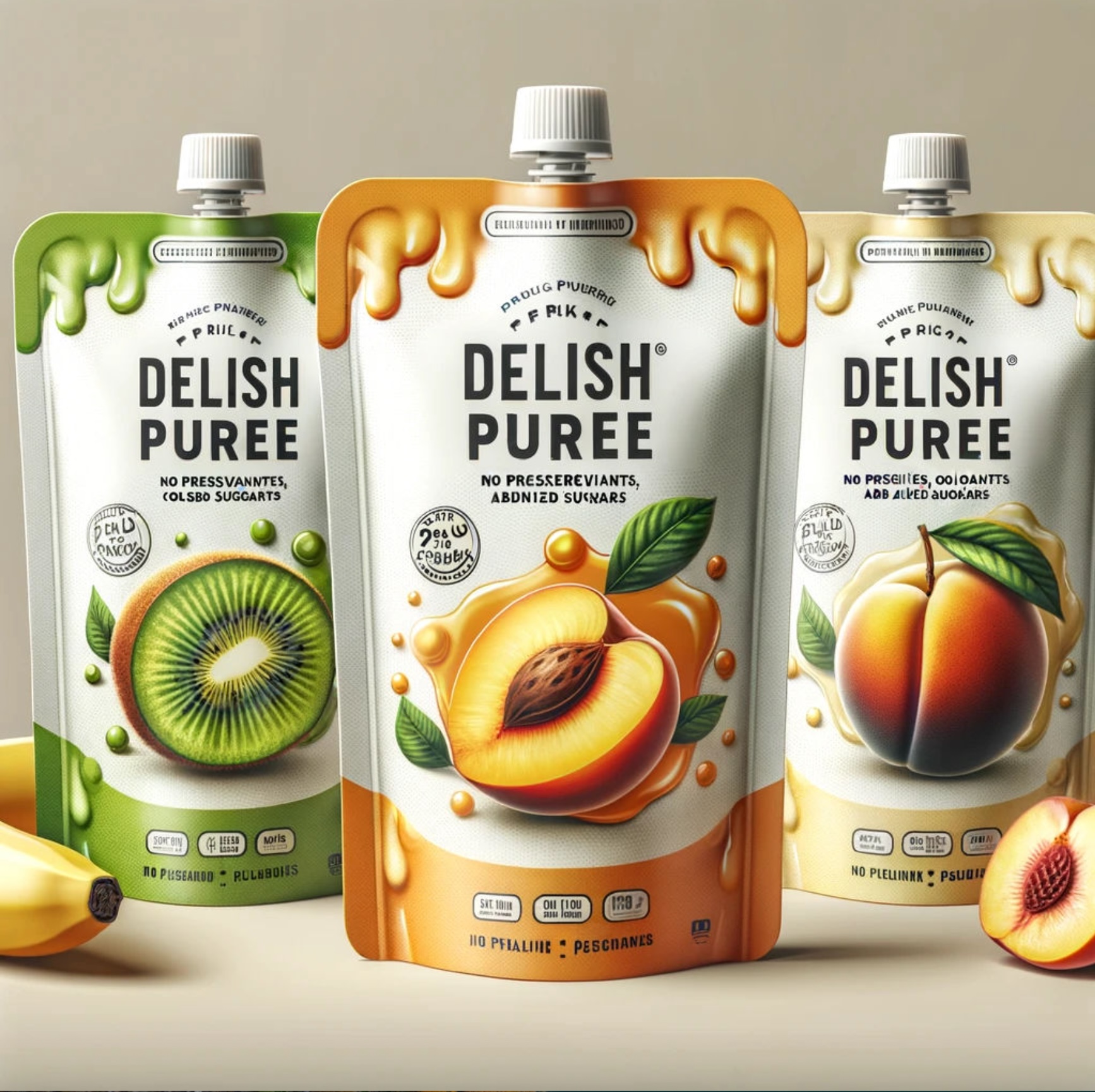
A spouted pouch is a stand-up pouch with a molded fitment — a spout plus a cap — so the user can pour a liquid or semi-liquid and reseal it without a clip. If you're sourcing them, the three numbers that decide your spec are the spout bore, the film structure, and the minimum order. Here's the straight version from our production side.
Custom spouted pouches start at 100 pieces with digital printing (HP Indigo) and 5,000 with gravure. Sampling runs 3–5 days; mass production is 7–15 days after you approve the proof. The rest of this guide tells you how to pick the spout, the cap, and the film — and exactly what to send a factory so the quote comes back as a number, not a range.
What a spouted pouch actually is
Take a stand-up pouch, add a die-cut hole, weld a spout fitment through it, and cap it. That's the whole idea. The fitment is what separates it from a zipper stand-up pouch: instead of tearing a seal and hoping the zipper holds, the user twists or flips a cap. For anything that pours — puree, juice, sauce, detergent, liquid supplement — that cap is the difference between a clean pour and a mess.
Spout bore: match it to what comes out
The spout bore is the inside diameter of the opening. There's no single "right" size; it follows the product.
- Small bore (commonly around 8 mm) suits condiments, samples, and single-serve viscous products where you want a controlled dribble.
- Mid bore (around 10–13 mm) is the common all-rounder for sauces, honey, and thicker purees.
- Large bore (commonly 16–22 mm) fits drinkable volumes — juices, smoothies, ready-to-drink supplements — where the user drinks or pours freely.
If your product is thick, go smaller so it doesn't glug; if it's drinkable, go larger so it flows. When in doubt, tell the factory the viscosity and fill volume and let them recommend — that's a standard question on any quote.
Cap type: screw vs flip-top
Two caps dominate the category, and the choice is about usage frequency, not quality.
- Screw cap seals tighter and is the safer default for products that ship long distances or need a tamper-evident feel. It can also take a child-resistant version for certain markets.
- Flip-top (snap) cap opens with one hand and is better for high-frequency use — a daily beverage or a sauce on the table. The trade-off is a slightly less positive seal than a screw cap.
Neither is "better" universally; pick by how the end user actually opens it.
Film structure: barrier follows the product
The pouch body is a laminate, and the middle layer decides the barrier. Three structures cover most spouted applications:
|
Structure |
Barrier |
Relative cost |
Typical use |
|
PET / PE |
Moderate |
Lower |
Dry fills, mild liquids, short shelf life |
|
PET / VMPET / PE |
Good |
Mid |
Snacks, moderate-shelf liquids, light protection |
|
PET / AL / PE |
Highest |
Higher |
Coffee, sensitive liquids, long shelf, oxygen/moisture critical |
For a sauce or baby-food puree that sits on a shelf for months, the aluminum (AL) layer in PET/AL/PE is commonly the right call because it blocks oxygen and moisture most effectively. For a detergent or a short-life product, PET/PE is often enough and costs less. We spec the barrier from what's inside and the required shelf life — send us the product and we'll recommend the structure rather than upselling foil by default.
When a spouted pouch fits — and when it doesn't
Best use cases
- Liquids and semi-liquids that need a controlled pour and reseal: baby-food puree, juice, sauce, honey, liquid supplement.
- Products where cutting rigid-bottle weight and freight matters, but you still want a clean pour.
Limitations / not recommended for
- Carbonated products — a flexible pouch can't hold the pressure; use rigid.
- Very high-temperature retort fills unless you specify a retort-grade structure up front; standard laminates aren't rated for it.
- Dry snacks or powders that just need a scoop — a zipper stand-up pouch is simpler and cheaper; you don't need the fitment.
MOQ and lead time
Production and shipping are different clocks. Our windows:
- Digital printing (HP Indigo): from 100 pieces. No plate fee, so a 100-piece test run or a multi-SKU launch is realistic.
- Gravure (cylinder): from 5,000 pieces. The cylinder cost is real, but we subsidize it against your order quantity, so it weighs less per unit as volume climbs.
- Sampling: 3–5 days — a physical pre-production sample on the actual material, not a PDF.
- Mass production: 7–15 days after you approve the proof.
- Transit: sea or air, quoted separately.
A first spouted order — sample approved mid-week — is typically in production within two to three weeks of your inquiry, before freight.
What to send a supplier for a real quote
Most "can you quote a spout pouch?" emails come back as a range because they're missing the things that set the price. Send this and you'll get a number:
- Bag type — spouted stand-up (vs spouted flat).
- Volume / fill weight — drives size and spout bore.
- Spout bore and cap type — or tell us the product and let us recommend.
- Material structure & barrier — e.g. PET/AL/PE for a shelf-stable sauce.
- Product inside — liquid, semi-liquid, or powder; viscosity if liquid.
- Quantity — per design, per run.
- Print — colors and whether artwork is print-ready.
- Finish — matte, gloss, soft-touch.
- Destination market & required certs — e.g. food-contact grade for baby food, FDA/BRC where applicable.
We turn that list into a quote with MOQ, lead time, and plate treatment on the first line.
Why our setup works for small and large spouted runs
We don't run one factory. We work with a network of 10+ certified partner factories — each holding CE, ISO, FDA, BRC, and food-contact-grade status. For every order we match the plant that fits your material, volume, and destination market.
What that means for you: a 100-piece digital test and a 50,000-piece gravure reorder both go to the right line. You can audit the factory, and you can talk directly to the production manager rather than relaying through layers of sales. Samples are free, and we credit the sample cost into your order once you place it — so testing a new spout size doesn't cost you twice.
Ready to spec yours?
Send the nine-point list above through our contact page and we'll return a quote with MOQ, lead time, and plate treatment on the first line. If you're still deciding on format, start with the spouted pouch range, or read our custom pouch MOQ & lead-time guide for the full digital-vs-gravure breakdown.