
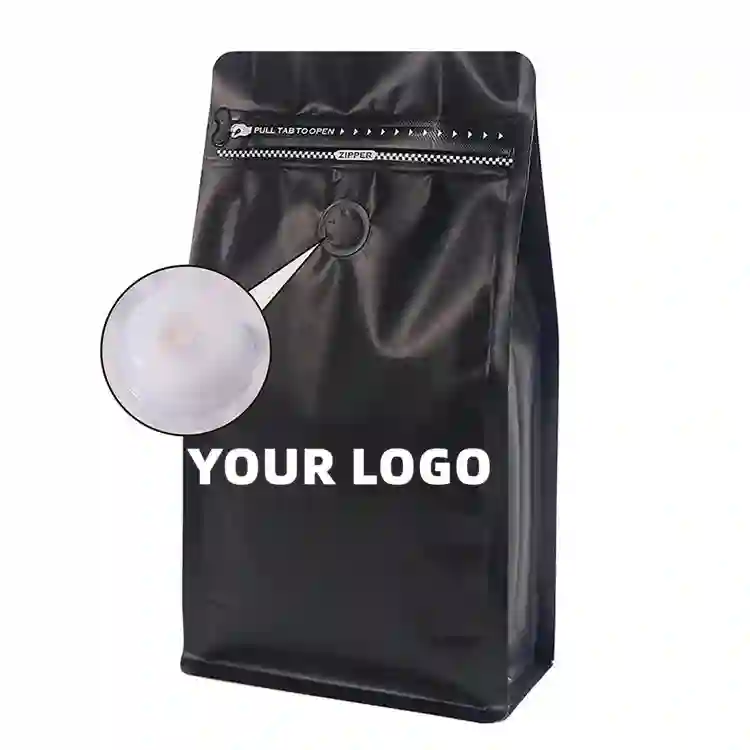
If you've ever sealed freshly roasted beans into a bag and come back the next morning to find it puffed up like a balloon, you've already met the problem a degassing valve solves. Roasted coffee keeps releasing carbon dioxide for a while — and if that gas has nowhere to go, the bag bloats, the seal takes the strain, and in a worst case it can burst open in transit.
So the little round plastic patch on a coffee pouch isn't a "breathable hole" in the way people often picture it. It's a one-way degassing valve. That distinction matters, because a real hole would let oxygen straight in — and oxygen is the thing that actually stales your coffee.
Why the valve exists in the first place
Right after roasting, beans are full of CO₂. They push most of it out over the first few days, then keep trickling gas for two to four weeks depending on roast and grind. During that window the bag needs to vent, or it builds pressure.
A one-way valve handles exactly that. When the pressure inside the bag exceeds the air outside, a thin membrane flexes open and lets CO₂ escape. The moment internal pressure drops — which is most of the time once degassing slows — the membrane closes and stays shut. Oxygen can't get back in. You get the gas out without letting the enemy in. That's the whole trick, and it's why almost every specialty roaster ships in valved bags.
Is there a required size and position?
There's no law, but there is a strong industry default. The valve housing is almost always about 21 mm across (roughly 0.83 inch) — you'll see 20 mm and 23 mm variants, but 21 mm is what most filling lines and most suppliers stock. The patch area around it is a bit larger so it can be heat-sealed onto the laminate without leaking.
Position is where people actually get it wrong. A few practical rules we use when laying out a coffee pouch:
- Put it on the front panel, in the lower third. Centered or slightly off-center both work. You want it clear of the top seal, the zipper, and the tear notch.
- Keep it away from the side seals and the zipper. If the valve lands on a seal area it won't weld properly, and a valve sitting under the zipper can get compromised when the customer opens and re-closes the bag.
- Apply it before the final cross-seal. On a roll-fed line the valve is placed onto the film web, then the bag is formed and sealed. You can't reliably add it after the bag is made.
- Leave room for your branding. The valve is a fixed circle, so design the print around it rather than fighting it — most brands just let it sit as a quiet detail near the bottom.
None of this is cosmetic. A valve in the wrong spot either welds poorly (leak) or eats into print real estate you paid for.
Does the valve guarantee how long coffee keeps?
Short answer: no. This is the part that gets oversold.
The valve only does one job — it releases CO₂ during the degassing window. Once that's done, the valve just sits closed. What actually decides shelf life is the barrier film: how much oxygen and moisture can pass through the material over time. That's measured as OTR (oxygen transmission rate) and WVTR (water vapor transmission rate).
A valved bag made from plain kraft paper will still go stale quickly, because kraft breathes — oxygen walks right through the material regardless of the valve. Put the same valve on an aluminum-foil laminate (typically PET / AL / PE) and the OTR drops close to zero. Combine that barrier with a nitrogen flush at filling and a tight seal, and you're looking at roughly 6 to 12 months of good quality for whole beans. Ground coffee ages faster simply because there's more surface area exposed.
So the honest framing is: the valve is necessary, but it's not what preserves the coffee. The foil laminate, the nitrogen, and the seal do that. The valve just keeps the bag from blowing up while the beans are still exhaling.
What this means when you're specifying a bag
If you're ordering coffee pouches from us, the valve is a standard option on the custom coffee stand-up pouch with one-way valve and on our aluminum foil bags for coffee and tea. The real decisions that affect freshness are the film structure and whether you flush with nitrogen — not the valve itself. We'll match the material to your roast, bag size, and how long the product needs to sit on a shelf.
You can see the full range on the coffee packaging page, or just get in touch and tell us your shelf-life target — we'll spec the laminate accordingly.