
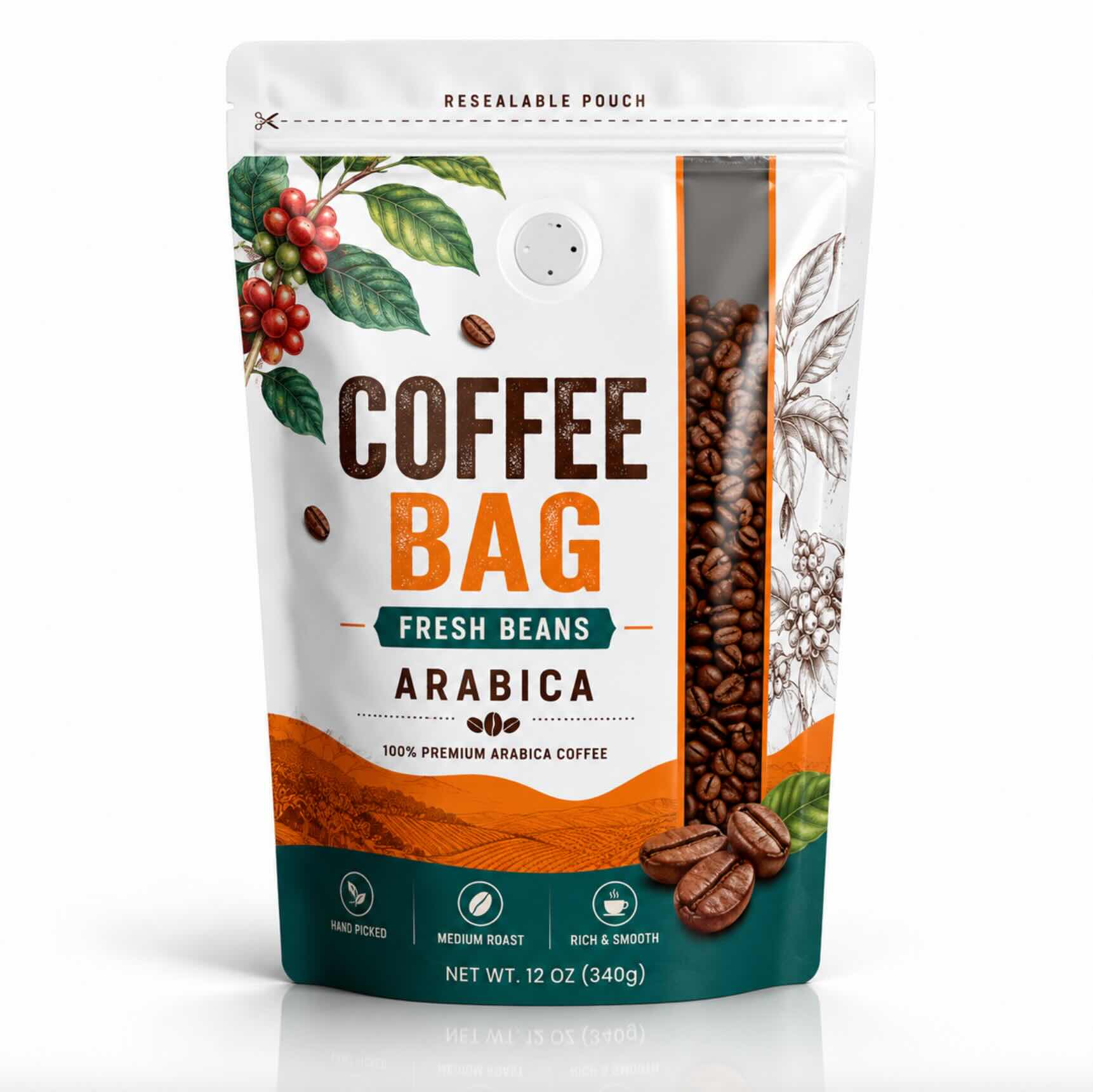
Short answer: which foil pouch do you need?
If you are packing coffee, protein powder, spices, or snacks and need the longest shelf life in a flat or stand-up pouch, start with an aluminum foil laminate (typically PET / ALU / PE, a 3-layer structure). Choose metallized film instead when you want a metallic look at lower cost and your product is less oxygen-sensitive. Get it printed when the pouch is also your retail shelf face. For low-volume runs, digital print now lets you order custom foil pouches from 100 pcs with no plate fee.
The rest of this guide explains the trade-offs so you can spec the pouch your product actually needs — not the one a catalog pushes.
Why foil at all? The barrier problem
Flexible packaging fails when oxygen, moisture, light, or aroma get through the film. Aluminum foil laminate blocks all four far better than a plain plastic or paper pouch:
- Oxygen & moisture: a foil layer is essentially a total barrier, so degassing coffee, oxidizing powders, and moisture-sensitive snacks stay stable far longer.
- Light: foil is opaque, which protects light-sensitive contents (e.g. vitamins, roasted coffee) from degradation.
- Aroma: foil holds volatile oils in — important for coffee and spice brands where smell is the product.
That is why "aluminum foil pouch" shows up for coffee, powder, and pet-food buyers: those products punish a weak barrier.
Foil vs metallized: the comparison buyers actually ask
This is the most common spec decision, so here it is directly.
|
Dimension |
Aluminum foil laminate |
Metallized film (MPET) |
|
Oxygen barrier |
Near-total |
Good, not total |
|
Moisture barrier |
Near-total |
Good |
|
Light barrier |
100% opaque |
Mostly opaque |
|
Puncture resistance |
Lower (foil can crease) |
Higher |
|
Cost |
Higher |
Lower |
|
Look |
Matte metallic, premium |
Shiny metallic |
|
Best for |
Coffee, long-shelf powders, wet/aromatic |
Snacks, short-shelf dry goods |
Rule of thumb: if shelf life and aroma retention are the selling point (coffee, premium powder), pay for foil. If you want the metallic shelf look on a budget, metallized is fine for less sensitive products.
The 3-layer foil bag structure explained
When a supplier says "industrial 3 layer foil packaging bags," they usually mean a laminate like PET / ALU / PE:
- PET (outer): print surface and puncture/scuff resistance.
- ALU (middle): the aluminum foil barrier layer.
- PE (inner): heat-seal layer that touches the product; can be switched to PP for retort.
Thickness is often quoted as total micron (µm), commonly 90–130 µm for stand-up foil pouches. The foil gauge itself is typically 6.5–12 µm. Do not assume "thicker = better barrier" — the foil layer, not total thickness, drives the barrier.
For products needing extra puncture resistance (e.g. pet treats with sharp edges), ask for a 4-layer structure adding nylon (PET / ALU / NY / PE).
Can you print on aluminum foil pouches?
Yes — and for most brands the print is the package. Two print routes:
- Digital print (HP Indigo class): no plate fee, low minimum order, fast turnaround. At 3NL this runs from 100 pcs, with sampling in 3–5 days and production in 7–15 days.
- Gravure (cylinder) print: lower unit cost at volume, but higher setup and a 5,000 pcs minimum, with plate/cylinder cost partly subsidized by order volume.
For test launches, seasonal SKUs, or small brands, digital print removes the MOQ wall that used to force a 5,000-pouch commitment. For stable high-volume SKUs, gravure wins on unit cost.
Food safety and certifications
If the pouch touches food, the inner layer and adhesives must be food-contact grade. Ask your supplier for the relevant certifications rather than assuming. At 3NL our partner factories hold CE, ISO, FDA, BRC, and food-contact-level compliance, and we support factory audits and direct communication with the production manager.
For U.S. and EU food brands, confirm:
- Inner film is food-contact approved (FDA for U.S., EU food-contact regulation for Europe).
- Adhesives are solvent-free / low-migration for the intended use.
- Print inks are low-migration for outer-surface print.
How to spec your foil pouch in one email
Send your supplier this and you will get a real quote instead of a catalog:
- Product + net weight (e.g. 250 g ground coffee).
- Barrier need (oxygen / moisture / light sensitivity).
- Pouch style (stand-up, flat, 3-side seal, spouted, with or without degassing valve / zipper).
- Print: how many colors, matte or gloss, digital or gravure.
- Quantity and target ship date.
- Certifications required (FDA / BRC / food-contact).
MOQ and lead time (real numbers)
|
Print route |
MOQ |
Plate/cylinder fee |
Sampling |
Production |
|
Digital (HP Indigo) |
from 100 pcs |
None |
3–5 days |
7–15 days |
|
Gravure |
from 5,000 pcs |
Subsidized by volume |
3–5 days |
7–15 days |
Samples are free and the sample cost is credited against your production order. With 10+ certified partner factories and factory-audit support, small brands can qualify the same supply base as large buyers.
Internal links (canonical /en/news/ paths)
- Compare coffee formats: Kraft vs Foil vs Valve Coffee Bags
- Order custom foil pouches: Custom Foil Pouches
- MOQ, lead time & print guide: Custom Pouch MOQ, Lead Time & Printing Guide
- Powder packaging material: Powder Packaging Material Guide
- Product category: Coffee Packaging · Powder & Spice Packaging
- Talk to production: Contact